The Navigation group has two tools. Page Layout selects one aspect ratio for every slide in the current presentation. Page Breadcrumb uses one table to maintain the stable Page Code and host breadcrumb display for every slide. Set the ratio before arranging content; configure page codes and breadcrumb rows after the page order and navigation are stable.
Feature
Feature: Page Settings & Page Breadcrumb
Use Page Layout to select one canvas ratio for every slide in the current presentation. Use Page Breadcrumb to maintain each page's Page Code, breadcrumb level, default text, language key, and background. Both are in the Navigation ribbon group.
What it is and what it's for
The Navigation group has two tools. Page Layout selects one aspect ratio for every slide in the current presentation. Page Breadcrumb uses one table to maintain the stable Page Code and host breadcrumb display for every slide. Set the ratio before arranging content; configure page codes and breadcrumb rows after the page order and navigation are stable.
Page Layout steps
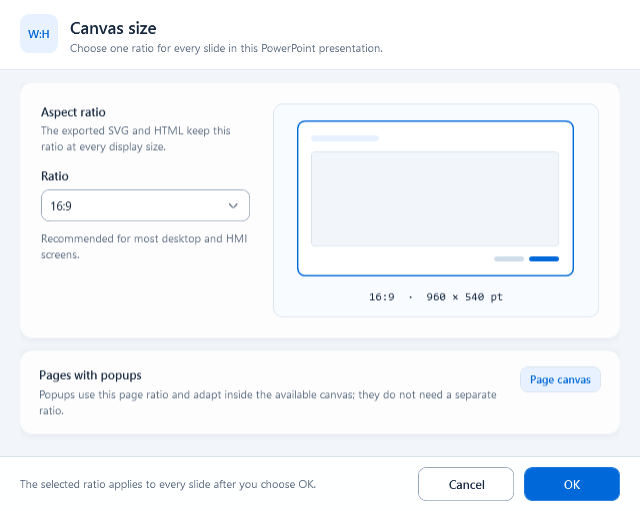
Click Navigation -> Page Layout. Choose 16:9, 16:10, 4:3, 3:2, or 21:9 in Aspect ratio. Review the description, canvas summary, and preview, then choose OK. The selected ratio applies to every slide in the current presentation.
16:9: recommended for most desktop and HMI screens.
16:10: adds vertical room for dense process information.
4:3: traditional operator panels and legacy displays.
3:2: balanced compact industrial displays.
21:9: ultra-wide control-room and wall displays.
A ratio change expands the canvas to keep existing coordinates visible instead of cropping them.
Pages with popups explains how popups adapt; an existing host side-panel setting remains independent.
Fill every Page Breadcrumb column
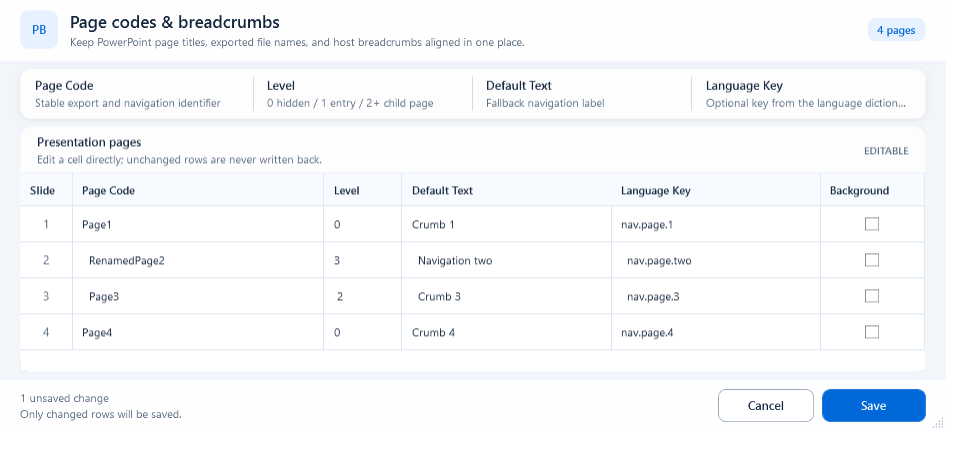
Click Navigation -> Page Breadcrumb. Presentation pages has one row per slide and editable cells. Unchanged rows are not written back. Choose Save to validate the full table and write only the changed rows.
Slide: read-only slide number used to locate the row.
Page Code: required stable export and navigation identifier. Start with an English letter, then use only English letters, digits, underscores, or hyphens.
Level: a whole number of 0 or greater. 0 hides the page, 1 is an entry page, and 2 or higher is a deeper child page.
Default Text: fallback breadcrumb label when Language Key is empty or has no translation.
Language Key: optional key from the existing language dictionary; it changes display text only.
Background: checked uses the PowerPoint slide background; unchecked keeps the exported page transparent.
Example:
Page Code = cc01
Level = 1
Default Text = PIY1C1
Language Key = navigation.cc01
Background = checked
Configure a presentation from ratio to navigation
Start with Page Layout and confirm one ratio for every slide. Plan one unique Page Code per page, then fill Level, Default Text, Language Key, and Background in Page Breadcrumb. Run Export HTML for the full package and test every breadcrumb level in HQControl.
Choose one presentation ratio.
Plan stable, unique Page Codes.
Fill Level in slide order.
For multilingual navigation, fill both Default Text and Language Key.
After full export, test entry pages, child pages, hidden popup pages, and back navigation.
When to use it
Use one Page Layout when main pages, detail pages, and popup pages share a screen package. Mark entry pages Level 1, deeper detail pages Level 2 or higher, and pure popup pages Level 0. For multilingual navigation, Default Text keeps the fallback readable and Language Key supplies the translation.
Boundaries and common mistakes
A few easy traps:
Page Breadcrumb covers only navigation level and name, not alarm scope. The breadcrumb node's alarm/fault state and the page's right-side alarm window share HQVISU_PAGE_ALARM from the current page's alarm.js document (read through getPageAlarm() at runtime; do not configure it twice)
Page Layout changes every slide in the presentation. It is not current-page only, and it has no custom width/height fields.
Page Code is a stable identifier, not a free-form display label. Follow its character rules.
Do not treat Level as a global site level; it is relative within the current screen package.
The host infers parent/child from export order plus level: the nearest preceding page with a lower Level becomes the parent, so keep the exported page order stable
Changing navigation structure (level, display name, adding/deleting/renaming pages) is a whole-package change and requires a full Export HTML, not a current-page-only export
Figure 1: Page Layout
Choose 16:9, 16:10, 4:3, 3:2, or 21:9 and apply the ratio to every slide in the current presentation.
Figure 2: Page Breadcrumb
Set each page's breadcrumb level and display name to control how it appears in the host navigation.